
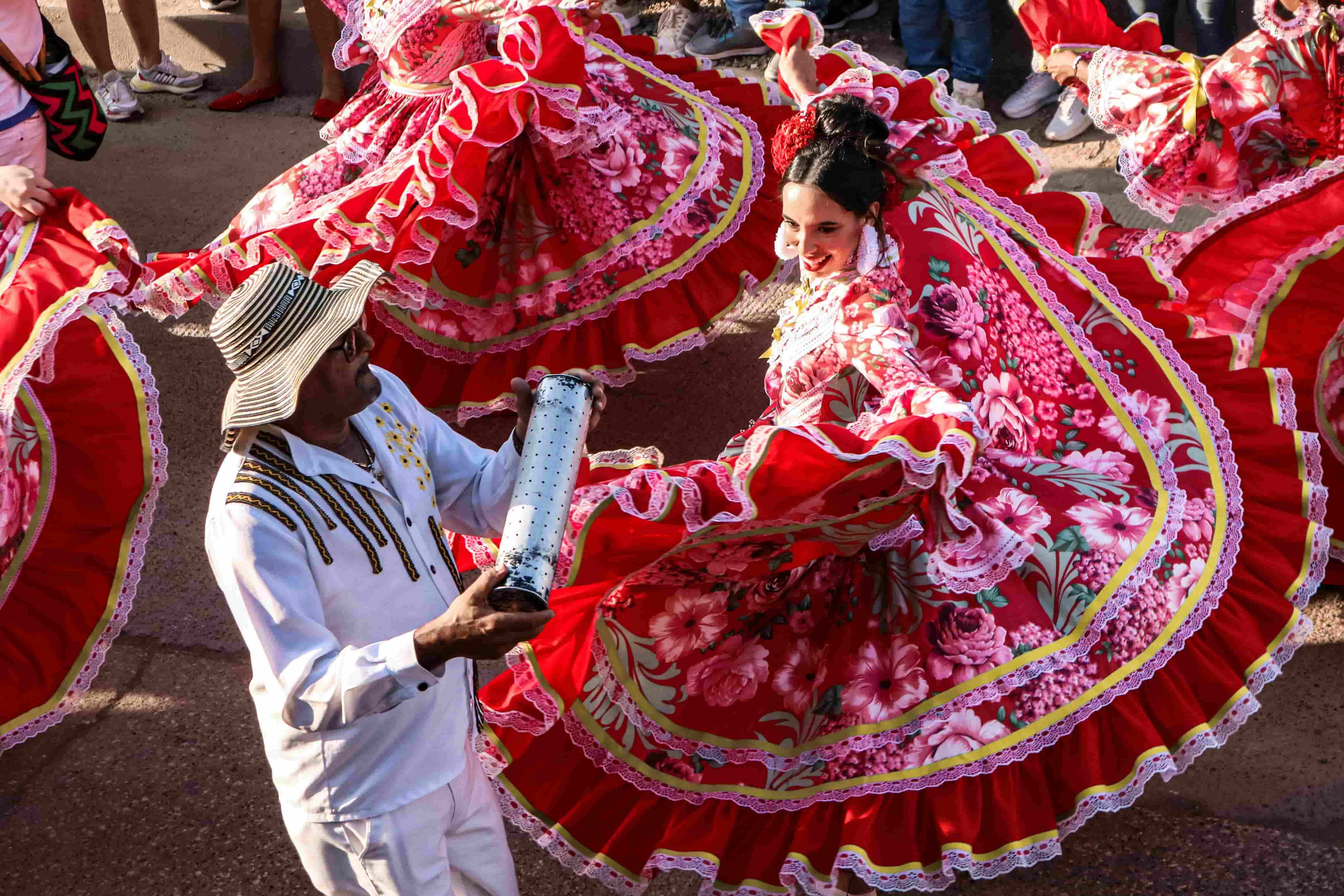
If Colombia had a soundtrack, it would be a complex, beautiful mix of Spanish guitars, African drums, and Indigenous flutes. In Colombia, we don’t just “play” music; we live it through dance. To understand our soul, you have to follow the beat.
1. Cumbia
The Mother of All Rhythms
Cumbia is the ultimate symbol of Colombian identity, born from the historical meeting of three cultures. It began as a courtship ritual during the colonial era, representing the union between African slaves and Indigenous peoples, with a slight Spanish influence in the clothing. It is the foundation of almost all tropical music in Latin America today.
- The vibes are hypnotic, elegant, and deeply soulful.
- The Dance: Women glide with short steps, holding lit candles to ward off their partners, while men dance around them with circular, respectful movements.
- The Outfit: Women wear the iconic pollera colorá (long, wide skirts) and flowers in their hair; men wear all-white outfits with a sombrero vueltiao and a red neckerchief.
- Where to see it: The Caribbean coast, especially during the Barranquilla Carnival.
You can watch the hypnotic movement of the Cumbia dancers here.
2. Vallenato
The Storyteller’s Song
Born in the rural valleys of the northeast, Vallenato is our “country music.” Long before the internet or radio, wandering musicians known as juglares would travel from town to town on donkeys, playing the accordion and singing the news of the day. It is a genre built on poetry and local gossip, making every song a short story.
- The vibes are joyful but often nostalgic, centered around the accordion.
- The Dance: A close-partner dance with subtle hip movements, where the focus is on listening to the lyrics and the melody.
- The Outfit: Casual Caribbean attire, often featuring the traditional mochila bag and light linen fabrics.
- Where to see it: Valledupar, during the Vallenato Legend Festival.
Listen to the most authentic Vallenato classics here.
3. Currulao
The Heart of the Pacific
This is the most sacred rhythm of Afro-Colombian heritage, deeply rooted in the tides and the dense jungles of the Pacific coast. Currulao is a ritual of community and spiritual connection, characterized by the magical sound of the wooden Marimba. It is a powerful reminder of the resilience and ancestral memory of the African diaspora in Colombia.
- The vibes are tribal and spiritual, dominated by the Marimba de Chonta (the “African piano”).
- The Dance: A dance of respect where partners never touch, using white handkerchiefs to flirt, signal, and create graceful shapes in the air.
- The Outfit: Flowy white garments that represent purity, peace, and the freedom of the Pacific spirit.
- Where to see it: Cali (during Petronio Álvarez) or the coastal towns of Buenaventura and Quibdó.
Feel the ancestral power of the Pacific Marimba here.
4. Salsa Caleña
The Fastest Feet on Earth
While Salsa has Caribbean roots, the city of Cali took the genre and added a “turbo” engine to it. Over decades, Cali developed a unique style characterized by extreme speed and complexity. It’s not just a dance there; it is a social movement that has turned the city into a global destination for dancers and performers.
- The vibes are electric, athletic, and incredibly fast.
- The Dance: Famous for “punteo” (lightning-fast footwork) and gravity-defying acrobatic lifts that look more like a sport than a dance.
- The Outfit: Sparkly, tight-fitting costumes designed for high-performance movement and maximum visual impact.
- Where to see it: The Salsotecas and specialized dance schools of Cali.
See the incredible world-champion Cali Salsa dancers here.
5. Joropo
The Cowboy’s Pulse
Coming from the vast Eastern Plains (Los Llanos), Joropo is the music of the Llanero—the Colombian cowboy. It is a fierce, rhythmic genre that mimics the work and life of the plains, from herding cattle to riding through the sun-drenched savannahs. It is one of the most technically demanding styles for both musicians and dancers.
- The vibes are high-energy and percussive, dominated by the harp, the four-stringed cuatro, and maracas.
- The Dance: A fierce zapateado (stomping) where the dancers’ feet mimic the rapid sound of a galloping horse on the dry earth.
- The Outfit: Men wear the Liqui Liqui suit and a wide-brimmed hat; women wear knee-length flared skirts with vibrant ruffles.
- Where to see it: Villavicencio or Yopal during the International Joropo Tournament.
Watch the fierce “zapateado” of the Joropo plains here.
6. Bambuco
The Spirit of the Andes
Bambuco is the heartbeat of the Colombian mountains, reflecting the reserved, romantic, and hardworking nature of the Andean people. It is a melodic genre that originated from a blend of Indigenous and Spanish influences. Unlike the explosive Caribbean rhythms, Bambuco is about subtlety, grace, and the “flirting” of a shy mountain courtship.
- The vibes are nostalgic and sweet, played with string instruments like the tiple (Colombia’s national instrument) and bandola
- The Dance: A respectful courtship dance featuring zig-zags, “brushing” steps, and a game of hide-and-seek between the partners.
- The Outfit: Intricate lace blouses for women and the traditional “carriel” leather bag, straw hat, and poncho for men.
- Where to see it: Neiva (during the San Pedro festival) or across the Coffee Region.
See the elegance of the Andean Bambuco dance here.
7. Mapalé
The African Fire
Mapalé is an explosive, high-speed rhythm that celebrates the liberation and strength of the Afro-Caribbean spirit. Legend says the dance was inspired by the movements of the Mapalé fish when it is caught and struggles out of the water. It is a dance of pure physical endurance that was originally performed at night by the light of a bonfire.
- The vibes are raw, frenetic, and powerful—it’s all about the beat of the drums.
- The Dance: Constant vibrating movements, high-energy jumps, and rhythmic contractions. It is physically demanding and visually stunning.
- The Outfit: Minimalist tropical clothing (often just short skirts or trousers) to allow for extreme physical exertion and heat.
- Where to see it: Cartagena and the historic town of San Basilio de Palenque.
Watch the explosive energy of the Mapalé dancers here.
8. Sanjuanero
The Festival Queen
A festive and choreographed variation of the Bambuco, the Sanjuanero has become the national symbol of Colombian folklore pageantry. It is the “star” of the mid-year festivals in the Huila region, where women compete for the crown by performing this dance with perfect precision, grace, and a constant smile.
- The vibes are grand, theatrical, and celebratory, it feels like a royal celebration.
- The Dance: A rigid but beautiful choreography of 8 “figures” (like the invitation and the pursuit) that tell a story of a man trying to win over a woman.
- The Outfit: Massive, heavy skirts adorned with colorful hand-painted flowers, sequins, and layers of lace.
- Where to see it: The Huila department during the “Reinado Nacional del Bambuco.”
Discover the complex choreography of the Sanjuanero here.
Legends of the Sound
Past & Present
The Hall of Fame (Historic Icons)
- Lucho Bermúdez: The mastermind who took rural folk music and arranged it for grand orchestras and ballrooms.
- Joe Arroyo: The king of “Joeson” and the voice behind the legendary anti-slavery anthem “Rebelión”.
- Totó La Momposina: The global ambassador who kept our ancestral Caribbean and river sounds alive on world stages.
- Pacho Galán: The master musician who created the Merecumbé rhythm by mixing Cumbia and Merengue.
The Modern Stars (Current Icons)
- Carlos Vives: The man who modernized Vallenato, fusing it with rock and pop for a global audience.
- Shakira: Who famously exported Colombian culture by blending Cumbia and Mapalé movements into global pop hits.
- Karol G & J Balvin: The leaders of the Reggaeton “Medellín movement” that has conquered world charts.
- ChocQuibTown: Pioneers in mixing the soulful Pacific Currulao beats with modern Urban music and Hip-Hop.
- Grupo Niche: The eternal symbols of Colombian Salsa, responsible for the city of Cali’s global fame.
Did You Know?
- 1,025 Rhythms: Colombia is officially the “Land of a Thousand Rhythms,” with over 1,025 different folk genres registered across its five natural regions.
- The Accordion’s Journey: The accordion used in Vallenato arrived in Colombia by total accident when a German ship wrecked near the Caribbean coast in the 19th century.
- Shakira’s Hips: The famous “hip shake” Shakira does is actually a blend of her Lebanese roots and the traditional Mapalé and Champeta dances from her hometown, Barranquilla.
- UNESCO Heritage: Both Vallenato and the music of the Marimba (Pacific) are recognized by UNESCO as Intangible Cultural Heritage of Humanity.
- Gabo’s Muse: The Nobel Prize winner Gabriel García Márquez famously said that his masterpiece, One Hundred Years of Solitude, was simply “a 400-page Vallenato.”
- The Tiple: Colombia has its own national instrument, the Tiple, a small 12-string guitar that provides the “metallic” and bright sound unique to Andean music.
Leave a Reply